

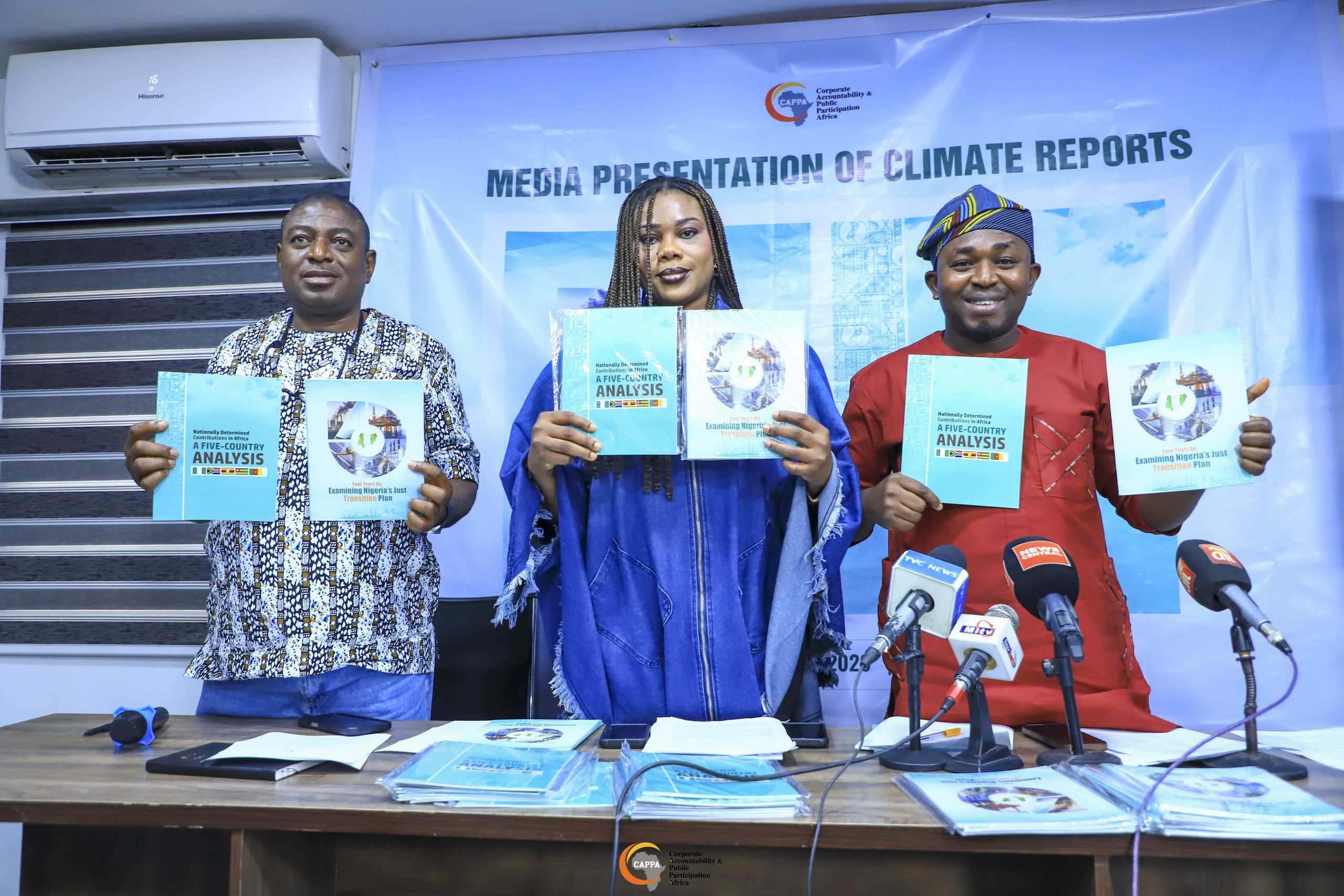
As governments, negotiators and civil society organisations gather in Antalya, Türkiye, for the 31st United Nations Climate Change Conference, COP31, Corporate Accountability and Public Participation Africa (CAPPA) and the Africa Make Big Polluters Pay Coalition launch two reports examining whether African climate commitments are delivering the changes they promise, and whose interests prevail when those promises meet the realities of economic power.
The first, Four Years On: Examining Nigeria’s Just Transition Plan, assesses Nigeria’s energy transition and the institutions, financing and social protections required to make it work. The second, Nationally Determined Contributions in Africa: A Five-Country Analysis, examines the climate pledges of Nigeria, Cameroon, South Africa, Togo and Uganda. Together, they reveal how the promise of climate action can be weakened by fossil fuel expansion, dependence on uncertain finance and policies that give investors greater influence than the communities whose lives are at stake.
These findings speak directly to the choices before COP31. Ten years after the Paris Agreement’s entry into force on 4 November 2016, the world remains dangerously far from its temperature goals. The United Nations Environment Programme’s (UNEP’s) latest Emissions Gap Report projects warming of 2.8°C this century under current policies, or 2.6°C if national climate pledges are fully implemented and comparable efforts continue. Even fulfilling existing promises therefore leaves humanity exposed to escalating harm, making the substance of national plans as important as their ambition.
For Africa, the stakes are inseparable from historical injustice. The continent accounts for less than three per cent of cumulative carbon dioxide emissions through 2024, excluding land-use change, yet the IPCC finds that climate change has reduced its agricultural productivity growth by 34 per cent since 1961.
While African governments must defend the continent’s right to development, they must ensure this right serves people’s needs rather than becoming a justification for prolonging extraction and corporate profit. Nigeria illustrates this tension. Our assessment recognises progress in policy development and renewable energy deployment but finds that cleaner energy is being layered onto an economy still heavily focused on oil and gas, without sufficient change in the institutions and revenue systems that sustain that dependence. The country’s net-zero ambition for 2060 sits alongside an official oil production goal of three million barrels per day by 2030, while Cameroon’s hydrocarbons corporation confirms five exploration blocks entering contract negotiations with Murphy West Africa and Octavia Energy. These decisions expose the difficulty of promising a transition while expanding the infrastructure that entrenches fossil fuel dependence.
The promotion of gas as a clean bridge to the future deepens this contradiction. Methane, the principal component of natural gas, is a powerful greenhouse gas, and methane emissions from all sources account for nearly 30 per cent of warming since the Industrial Revolution. As governments discuss implementing the COP28 commitment to transition away from fossil fuels, investments that prolong reliance on gas require scrutiny of their climate consequences and the public resources they divert from renewable alternatives.
Our Nigeria report also finds that the machinery for delivering justice remains weaker than the language promising it. Responsibilities are dispersed across institutions, financing relies heavily on anticipated investment, and workers and affected communities lack sufficiently enforceable guarantees of income security, retraining and environmental repair. With the World Bank reporting in March 2025 that more than 80 million Nigerians lack access to electricity, success must mean reliable, affordable power and secure livelihoods, alongside measurable emissions reductions. For the Niger Delta and other extraction zones, it must include restoring damaged environments and building viable economies beyond extraction.
Across the five countries, our comparative study raises a related concern about the growing place of carbon markets in climate planning. Offsetting allows buyers claim compensation for emissions through projects elsewhere, including forests and plantations, but carbon stored in vegetation can be released again through fire, land conversion or other disturbances. When such arrangements become an excuse to postpone cuts at the source, responsibility shifts from polluters to the land and communities expected to absorb their emissions.
Uganda’s climate plan reflects these choices, assigning far greater projected emissions reductions to commercial plantations than to its two natural-forest restoration measures. The risks extend beyond accounting: the Oakland Institute documents forced evictions associated with a forestry and carbon-credit project in Kachung, Uganda. Climate action loses its moral foundation when protecting a carbon asset takes precedence over protecting the people who depend on the land.
Financing pathways for advancing climate justice can also reproduce the same inequalities. Nigeria estimates that its climate commitments require US$337 billion between 2026 and 2035, with 80 percent expected from international funding, while Togo makes 69.9 percent of its financing requirement conditional on international support. South Africa’s NDC reports that approximately 80 percent of the international financial support recorded for 2021–2022 comes as loans. When countries must borrow to confront damage they have done little to cause, climate finance risks transferring the cost of historical pollution to its victims.
MBPP Africa partners contributing to the study connect these findings to demands for climate justice across the continent.
Ndivile Mokoena, Founder and Chief Executive of Yielding Intersectional Movements in South Africa, an MBPP Africa partner organisation, states, “The persistent gap between global climate commitments and local realities raises critical questions about political will and economic systems that continue to prioritise profit and growth over human well-being and ecological sustainability. This report underscores the urgent need to move beyond promises to tangible implementation, adequate climate financing, and meaningful support for developing countries.”
Emphasising community rights, Acola Amina, Executive Director of Nia Environment & Zero Carbon Alliance, an MBPP Africa partner in Uganda, notes, “Achieving a rights-based, ecofeminist climate agenda that reflects Uganda’s realities and responds to the needs of affected communities requires inclusive participation and collective commitment.”
Kwami Kpondzo, Executive Director of Centre pour la Justice Environnementale, an MBPP Africa partner in Togo, reinforces the coalition’s opposition to false solutions, saying, “Carbon markets and geoengineering are not solutions to the climate crisis. Rather, they are dangerous distractions that risk worsening the plight of vulnerable communities, threatening livelihoods, and undermining genuine climate action. We must put people and the planet before profit. Nature is not a commodity for sale, and we remain steadfast in our commitment to defending it.”
Addressing public accountability, Akinbode Oluwafemi, Executive Director of CAPPA, which hosts the MBPP Africa secretariat, says, “The Nigeria Energy Transition Plan and the Five-Country NDCs Reports offer an opportunity to rethink how energy policies and climate commitments serve people and communities. These reports emphasise that equity, transparency and accountability must remain central in every plan, while ensuring that affected communities have a meaningful voice in decisions that shape their future.”
We therefore call on the African Group of Negotiators and progressive delegates at COP31 to reject carbon offsetting as a substitute for emissions reductions and challenge net-zero accounting and Article 6 arrangements that allow continued fossil fuel pollution to be balanced against temporary or unreliable carbon storage. This must be accompanied by policies that prioritise natural forests, biodiversity and community-led restoration, rather than rewarding commercial plantations at the expense of ecosystems, agroecology and food sovereignty.
Such a shift requires binding safeguards against corporate capture, including conflict-of-interest rules that prevent fossil fuel companies, major industrial polluters and conflicted private consultants from determining national climate priorities. Workers, civil society and affected communities must have meaningful authority over these decisions, supported by transparent budgets, public access to information and enforceable accountability for climate spending.
We also demand legal protection for communal land and the livelihoods it sustains. Indigenous Peoples, smallholder farmers, rural women and frontline communities must have enforceable rights to prevent land appropriation for plantations, carbon projects and other climate interventions, including the right to refuse projects that threaten dispossession.
For these commitments to carry substance, historically responsible high-emitting countries must provide adequate, predictable, grant-based climate finance and reparations. African delegates must reject financing arrangements that deepen indebtedness, while insisting that international support strengthens democratically determined national interests rather than giving creditors and investors control over them. Finally, we demand a planned and funded phase-down of fossil fuel extraction and dependence, backed by substantial public investment in decentralised renewable energy, affordable and reliable electricity, and legally binding protections for workers and affected communities. Income security, retraining, secure employment, environmental remediation and livelihood restoration must be funded obligations within the transition.
